@Francois thanks for giving us the opportunity to playtest your prototype! It was fun to play and reflect on the experience.
Here are my notes from playing. I’m not sure what the design goals were so there may be instances where my expectations as a player differ from the goals. Some of the comments in here might have already been addressed during the event.
First, here’s some context:
- I haven’t played a roguelike or deck builder before.
- I played Rogue Story for several hours and completed several publishing runs. This was done over a few sessions.
- My last publishing run was on hard and was successfully completed. The rest were on easy.
- I tried around 3 styles.
- The only theme available to me was medieval
#1 Generated book text & reviews played a background role for me
As I was building chapters, I was mostly thinking about:
- Flow. How do I get enough to make it to the next round?
- A couple of times, I built a long nonsensical throwaway sentence to score a lot of flow so I’d earn enough to make it to the next round.
- How do I make a sentence that makes sense on its own and fits into the bigger story?
- How do I make a story that’ll meet market expectations (e.g. happy ending, cliff hanger)
When I completed a book, I wasn’t too interested in reading:
- The book text that the game generated for me in whatever style (e.g. haiku) I chose when starting the publishing run.
- The review headlines generated by the game. I only cared about whether it was positive or negative.
For several books and styles, I did read the book text and reviews but ultimately I didn’t find them to be that interesting and later gravitated towards skimming them.
To summarize, I cared very little about the content of the story I was writing and whether it was interesting. Instead, my focus was on the goals set by the game.
I think it’s a very cool idea to have the game generate book text and reviews based on your input. But my experience was that these were more like set dressing in that I glanced at them and they contributed to the game’s feel. They ultimately played a background role for me and I wasn’t too interested in reading them.
#2 Long-term fun
As I played, I naturally set goals for myself and pursued them until I achieved them. Then I naturally set a new goal for myself. These are what were motivating me to play. These were some of my goals:
- I was curious to discover the different kinds of:
- Tarot cards
- Card upgrades
- Market expectations
- Successfully complete a publishing run
- Unlock new styles (e.g. haiku)
- Related to #1, after realizing the book text wasn’t too interesting to me, unlocking and trying new styles also became much less interesting to me.
- Successfully complete a publishing run on hard
- Unlock new themes (e.g. Detective Noir)
- I never achieved this and it’s unclear to me whether it’s actually unlockable in the prototype
After I completed those, I didn’t have another strong goal in mind so my motivation to play decreased a lot. If the game is only intended to be played for several hours, perhaps there should be a satisfying conclusion so people feel like they’ve completed the game. If the game is intended to be played for many many hours, this raises the question of what keeps the game fun over the long-term?
Another note is that, after playing for several hours, I started encountering the same sorts of cards/scenarios (e.g. “The Physician”). This felt repetitive because I tended to construct the same sorts of stories with minor variations to satisfy whatever the current market expectation was.
#3 Difficulty/balance
The first few times I failed the publishing run due to insufficient flow. In later runs, this wasn’t a problem. I’m not sure what changed. It could be:
- The game changed (my first publishing runs were on game version
V00.14.01 while subsequent ones were on V00.15.00)
- My strategy improved
- Luck
In later runs, I settled on a strategy but I didn’t have a feel for whether it was actually a good strategy. I was consistently finishing publishing runs but I didn’t have a feel for whether it was due to the strategy or luck. The strategy was like this:
- When shopping
- Increase flow. This was my ultimate focus. I bought the cards that seemed to me would be best for increasing my flow.
- Increase money. The goal of this was so that I could afford more cards to increase my flow. I was especially focused on this in the first book or two. In some runs, after that, I’d have more than enough money for the rest of the run. Some of my favorite cards doubled my balance or increased my balance by the sell value of my tarots.
- When writing sentences I focused on
- Writing sentences that made sense on their own and fit into the bigger story
- Writing sentences that satisfied the market expectations (e.g. happy ending, cliff hanger)
- Writing sentences that increased my flow by a lot.
- I did this mostly by constructing long sentences. Including multiple adjectives helped.
- For the most part, I didn’t pay attention to what my tarots specifically did. It felt like too much to pay attention to (even without worrying about this, constructing a sentence took me a while). One exception was the tarot that said something like “Playing card X earns you an extra Y flow.” I paid attention to that one and used it as much as possible (it tended to be easy to find a way to fit the word into the sentence). The game lit that card on fire which made it very easy to remember to use this tarot—very helpful.
A few observations:
- My shopping strategy was vague. It was just “increase flow”. It wasn’t something more specific like optimizing for magical cards or light cards.
- There was a disconnect between my shopping strategy and my sentence construction strategy in that, when constructing sentences, I didn’t really pay attention to the specific tarots I had. I just tried to construct long sentences and hope for the best in terms of earning flow. This strategy seemed to work in that:
- I generally earned enough flow in publishing runs
- The one time I played on hard, I successfully completed the publishing run. It didn’t seem any more difficult than easy so I couldn’t tell the difference between the easy and hard modes.
- After constructing a sentence, I had a hard time understanding where its flow value came from. This isn’t surprising in that, when constructing a sentence, I didn’t pay attention to the specific tarots I had. When finishing a sentence, the tarots would rapidly bounce as it summed up the sentence’s flow but this happened so fast that it was hard to follow the details of why I was earning the flow. Some sentences would earn a ton of flow and I couldn’t really tell why.
#4 Learnability
This section has some notes about things that confused me in the game.
4a Improve visibility of special card
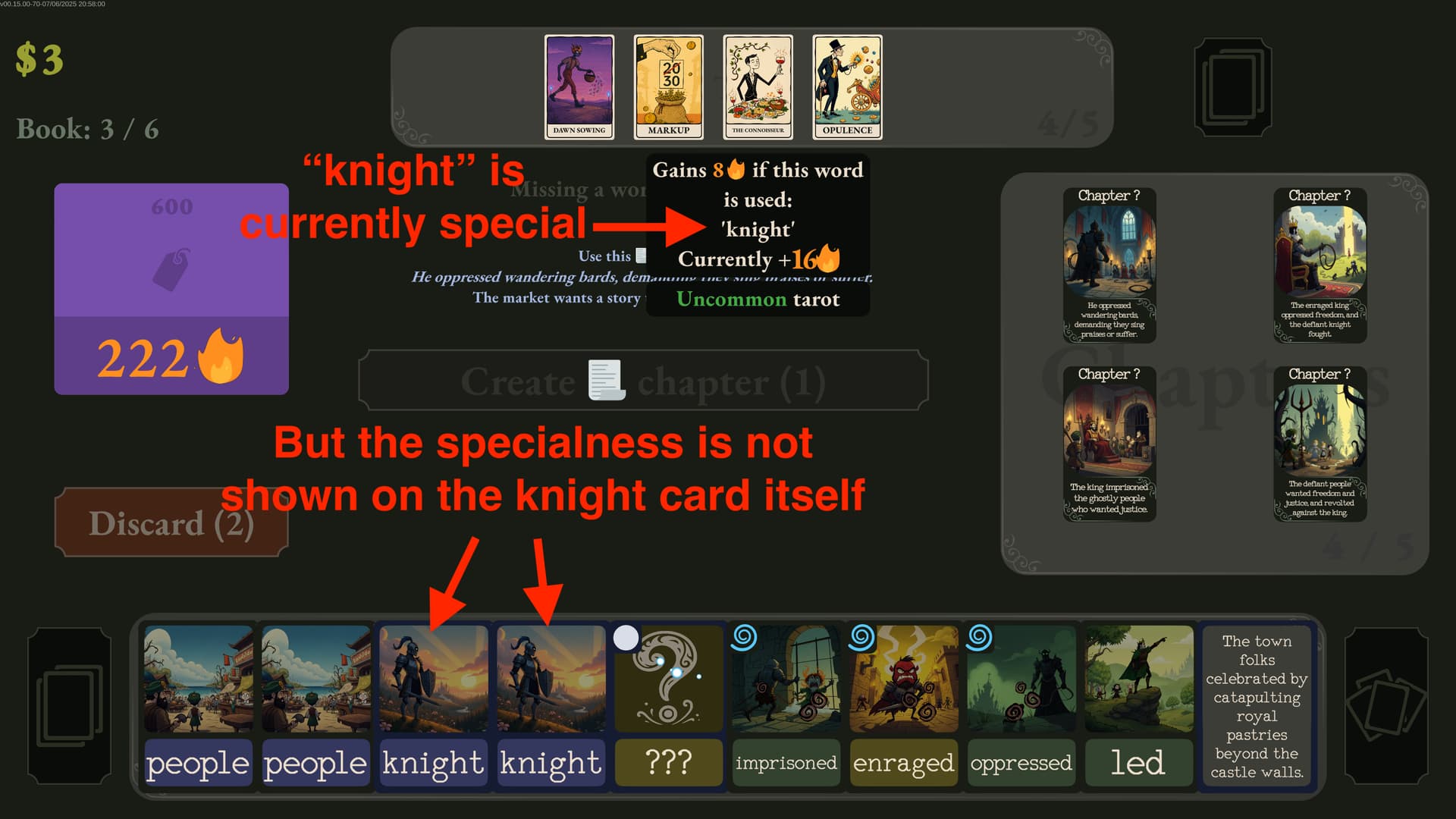
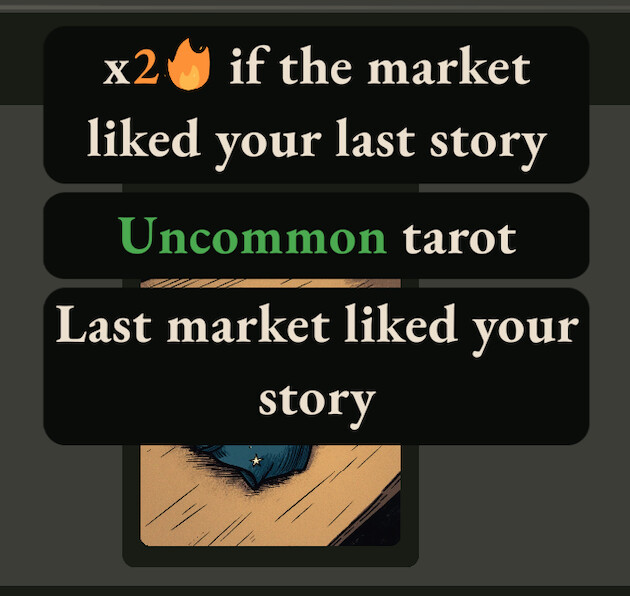
I have a tarot card that causes a specific card in my hand to earn extra flow. As can be seen from hovering the card, the special card is currently the “knight”.
It’s easy to forget about this tarot card and forget to hover over it each hand to check which card is currently special.
To make it easier to keep this tarot card’s effects in mind, the special card itself should be highlighted. That way, you don’t need to remember to hover over any card. The special abilities will be obvious to the player just by looking at their hand.
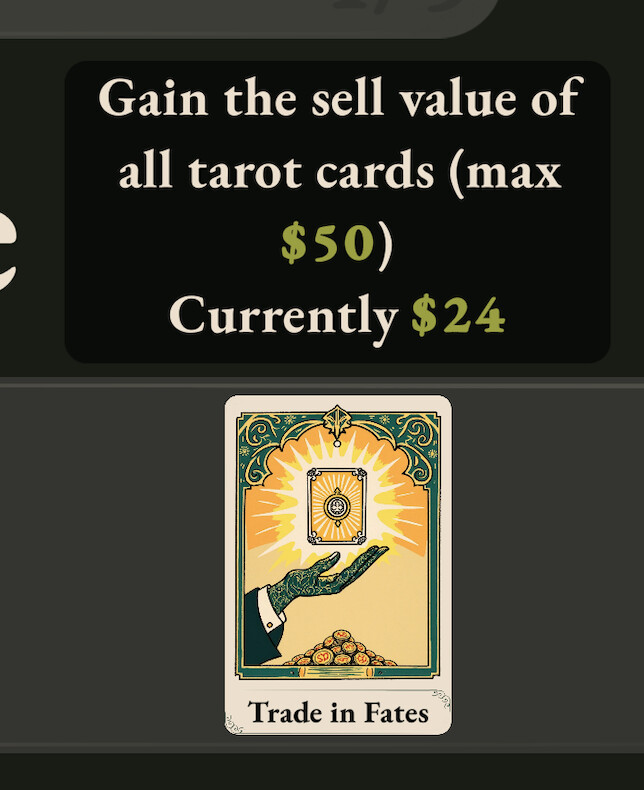
4b Max gain or max balance?
Does this mean this card will earn me at most $50 or that my balance will be capped at $50?
Not related to this problem but, thinking about this card, I was wondering if this wording would be clearer:
Gain $24, the sell value of all tarot cards
That way, it tells you exactly what effect this card will have in this moment without the player having to manually combine the info “Currently $24” with the card’s description. I think that’s a good design goal in general: to describe the card’s effects in this moment as directly as possible so the player doesn’t have to reason through them.
Also, how do I know whether this card is only used once or gets used at the completion of every chapter or book?
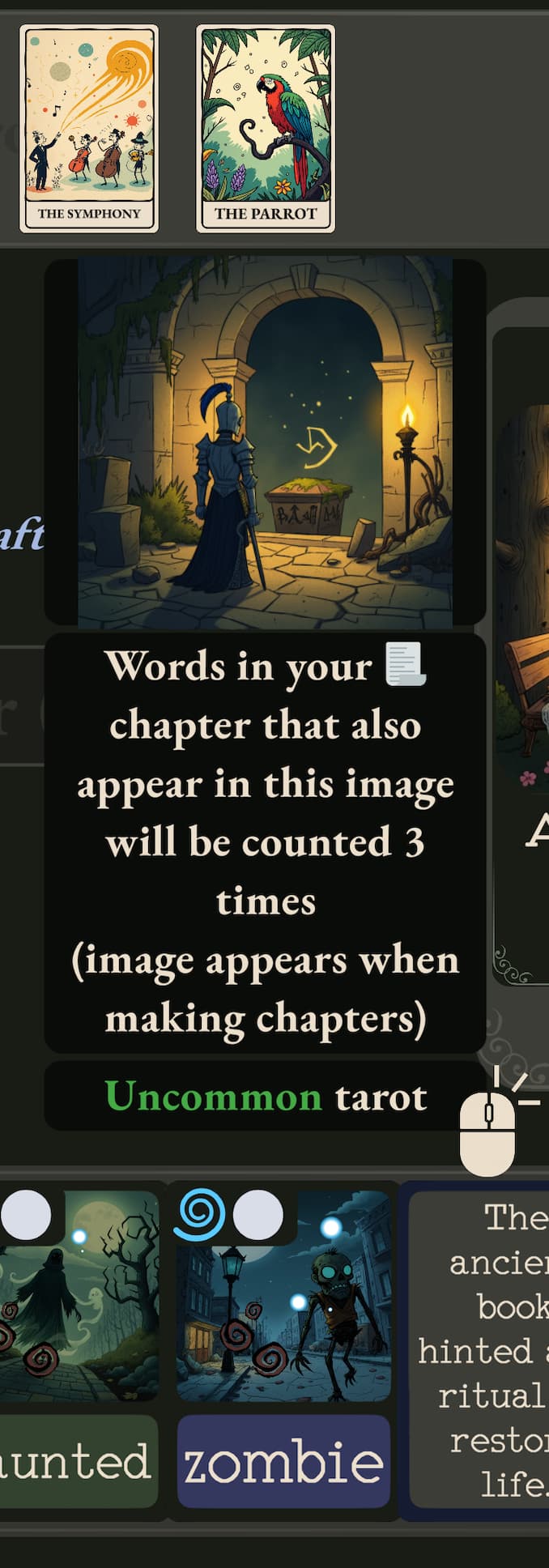
4c What does “image appears when making chapters” mean?
Maybe it means that the card’s image changes every time you start on a new chapter?
Maybe it’d be better to communicate the image’s dynamic properties through the design of the image itself rather than through the card’s descriptive text. That way the image conveys its own behavior instead of the player having to read about it.
4d Clarity around multiplier communication
I found the way multipliers are conveyed in Rogue Story to be a little confusing.
If I recall correctly, some were conveyed as percents (e.g. 0.25%) and others as multiplication (e.g. x0.5). I’m guessing percents and multiplications are essentially the same but you pick the representation that’ll use fewer digits. Maybe it’s worth standardizing on one representation to avoid the risk that people think there’s an important difference between percents and multiplications.
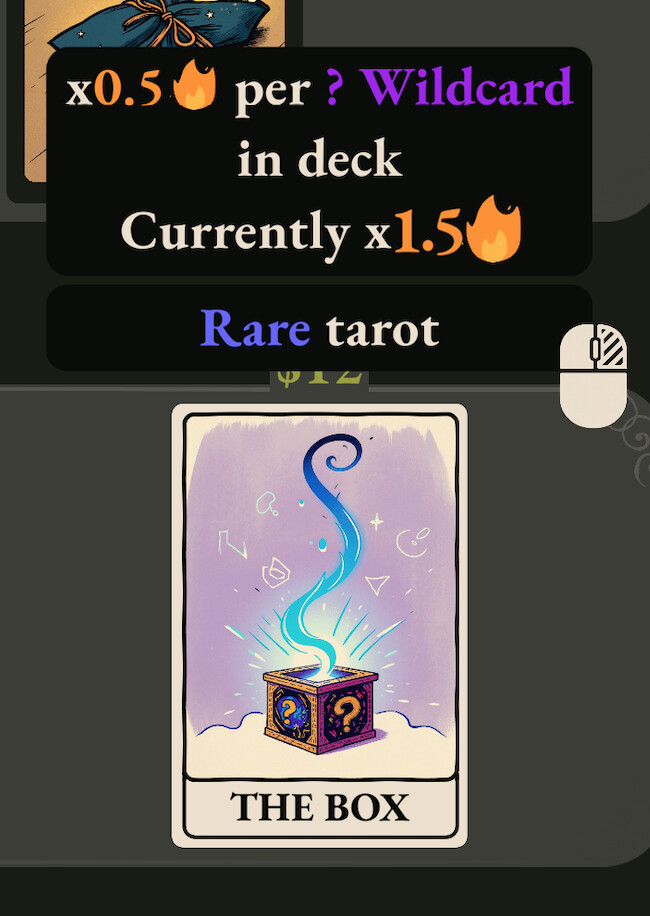
Whenever I saw a multiplier smaller than 1 like x0.5, I wondered whether it was a downgrade. In the screenshot below, if I only had one Wildcard in my deck, would this tarot card give me a multiplier of x0.5 and so it’d hurt me by cutting my flow in half?
I found the multiplier notation “x0.5” a little confusing in that my brain is surprised there’s no number before the “x” and it wonders what 0.5 is being multiplied against.
4e Confusion about my cards vs book’s cards
I haven’t played a deck builder before and it took me a while to realize there was a distinction between “my cards” which are with me forever and “the book’s cards” which change every book. Here’s how I came to realize there was a distinction:
- I noticed that I had cards in my hand that weren’t shown to me when starting the book.
- I wondered what “upgrading a card” meant since I get a new set of cards every book.
Thinking about these observations, I eventually realized the distinction between “my cards” and “the book’s cards”. When starting a book, seeing all the cards animate into “my card deck” in the top-right corner helped with this realization. It was also helpful to be able to click on “my card deck” in the top-right corner and see what was in there.
4f Clarity about distinction between a “book gift” and a “potion gift”
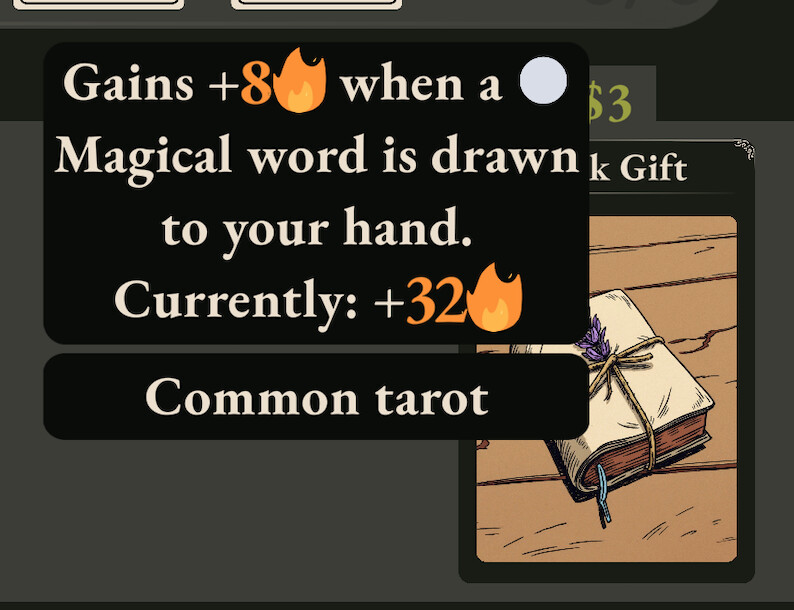
I think I figured out the distinction while exploring the shop but I always forget the difference.
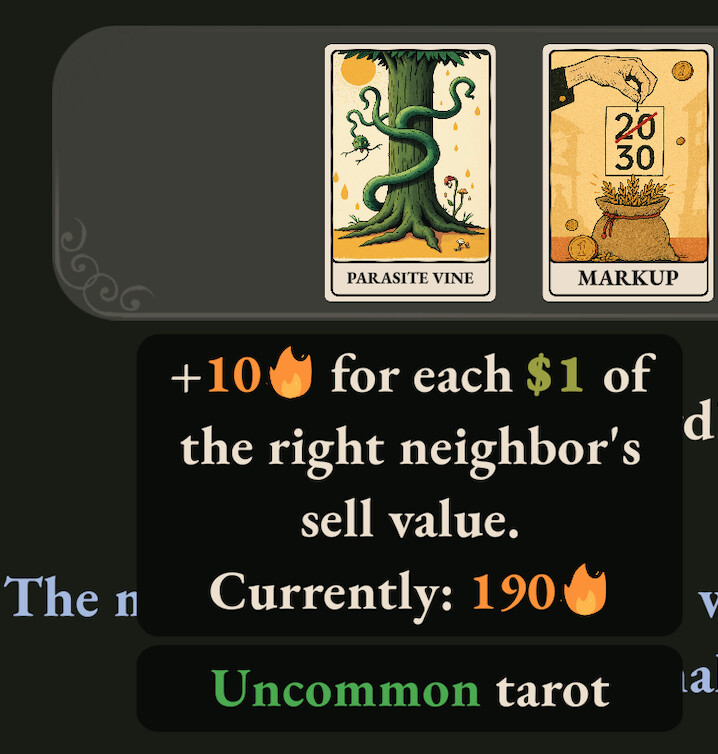
4f Per chapter or per book?
These cards give flow bonuses. Do they take effect each time I complete a chapter? Or when I complete a book?
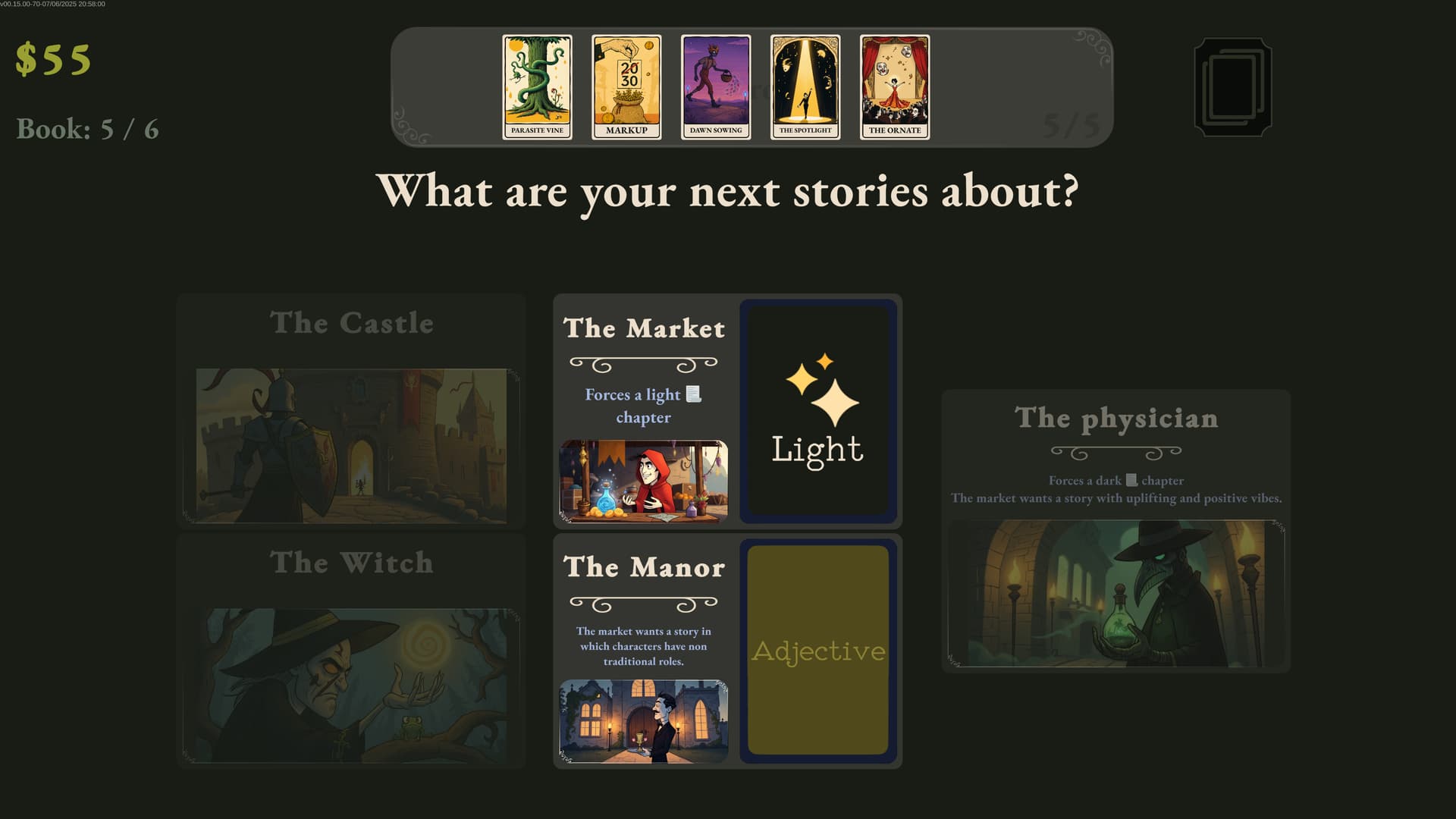
4g How do I access the greyed out stories?
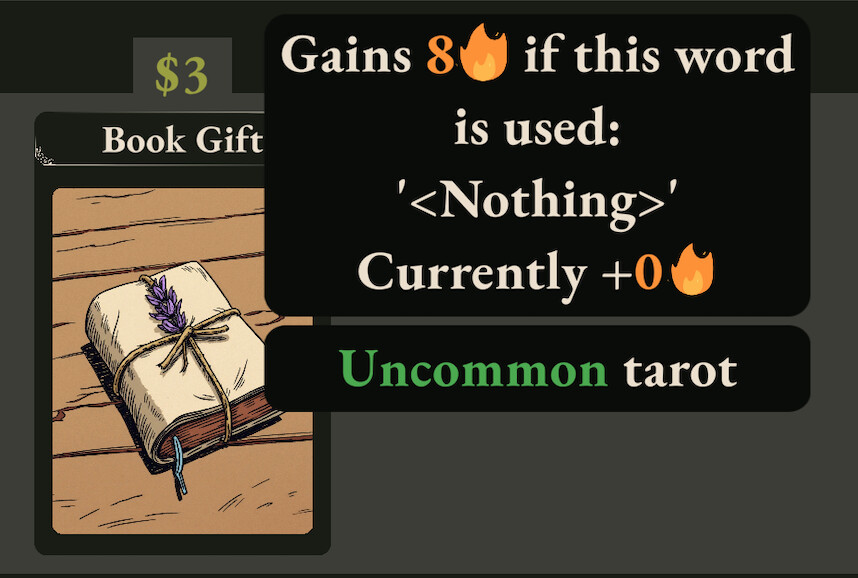
4h What does '<Nothing>' mean?
This is a screenshot from the shop.
#5 Miscellaneous
- Observations
- The art and animations had a nice impact on the game’s atmosphere.
- I liked the game’s structure and how it contributed to the atmosphere (e.g. playing as an author writing books as a part of a publishing run). I like the phrase “publishing run.”
- Critique
- After finishing a book, the typewriter scrolls too fast for my reading speed. Consider letting the player have some control over the scroll rate.
- Consider adding a button to deselect all cards.
- When constructing a sentence, I might select several cards to see the sentence they form. I might decide I want more card options, so I start selecting cards I don’t want so I can discard them. Then when I go to hit “discard”, I realize the cards from the sentence I was constructing are still selected and about to be discarded—but I want to keep these. If there was a “deselect all cards” button, maybe I would click it in between constructing the sentence and selecting the cards to discard.
#6 Game variations
Playing the game sparked some ideas for some related game ideas. I’m not sure what direction you want to take Rogue Story so I’m not sure whether these ideas are of interest but I’ll share them anyway.
6a Mad Libs
While playing Rogue Story, I was thinking about prior successful games where the player and the game collaborate on writing a story. Mad Libs came to mind. I haven’t played it in a long time but remember ending up with hilarious stories when playing as a kid.
Perhaps Mad Libs contains some relevant ideas or lessons. Mad Libs is a pen & paper game. What would it look like as an AI-powered video game?
6b Scaffolded creative writing
I mentioned earlier that I wasn’t too interested in the game-generated book text or reviews and that they became background elements to me. I was thinking about how to design the game so that these would become the focus, the player’s main interest.
What I came up with was a bit like creative writing. The player would write a story in a text editor meeting the constraints/goals set by the game and with the AI’s assistance.
Rogue Story provides these sorts of constraints/goals and I think this sort of structure would be helpful for this too:
- Theme (e.g. medieval)
- Style (e.g. comedy)
- Market expectations (e.g. cliff hanger)
- Scope (a Rogue Story publishing run lasted up to an hour for me and I think aiming for a limited time would be helpful for creative writing too)
- Reviews (the player could receive real feedback on how their writing did related to the goals they were pursuing)
The AI could act as a writing assistant to the player during the writing process. They can write together in little pieces. It can help with things like phrasing and brainstorming.
The AI could generate visuals for the book like illustrations or a book cover.
Like in Rogue Story, as the player completes rounds, they could unlock more themes, styles, story goals, art styles, etc. Since the player’s focus is on the story content, I think the player could have a strong drive to unlock new things because they’ll have a significant impact on what the player is thinking about while playing. They could also be a strong motivation because they could be related to the player’s desire for self-expression (e.g. “I want to try writing a science fiction story with a cliff hanger and I want its illustrations to look like claymation”). Gradual unlocking of these things also seems good from a pedagogical perspective: it lets the player focus on 1 writing skill at a time, and, over the long-term, they get practice at a variety of different writing skills.
Thanks again for letting us playtest and critique the prototype!
If you have any questions or want more details, let me know!
 Subscribe to Educational Game Club to get notified each time we schedule an event.